
Refinance
Refinancing a Virginia home has a special tax exemption…

September 28, 2009 by Doug Francis · Leave a Comment
Last week I attended a conference at George Mason University where a number of economists discussed many real estate related topics. One panelist, Dr. Frank Nothaft who is the Chief Economist of Freddie Mac, commented how mortgage rates are at almost 50 year lows and are probably going to remain low for the next 6-12 months.
So if that encouraged you to look into refinancing your home, please remember that Virginia residents who refinance with the same lender (read more) qualify for a recordation tax exemption. Compare rates but understand that this may save you some serious cash over those other lenders competing for your business.
I decided to regurgitate this post since rates have been up and down all year long, and some of you may be thinking about refinancing. There are plenty of mortgage people out there, but remember that I know some too that I am happy to refer!
Related articles by Zemanta
- Fannie Mae Tightens Lending Requirements for IO Loans and ARMs (home-mortgages.suite101.com)
- Qualifying For VA Jumbo Loans (prweb.com)
Refinance
The truth about Option-ARM’s and traditional ARM’s
September 9, 2009 by Doug Francis · 1 Comment
What the heck is an Option-ARM and why do they get headlines?
In the Option-ARM mortgage, the borrower can decide how much she will pay each month. For example, the true Principal and Interest payment is $1,500 per month but the borrower decides to pay only $1,300 per month.
That extra $200 per month then gets added to the principal due. It adds $2,400 annually to the mortgage balance, which isn’t much when house prices are going up 10% per year.
But when the market is declining then this is a recipe for disaster. None of my clients used these mortgages and the Option-ARM product is no longer available.
OPTION-ARM’s are the single most toxic element in the existing mortgage crisis that continues to unfold across the country.
And they have tainted the reputation of traditional ARM’s… so please keep reading.
ARM is an Adjustable Rate Mortgage:
- The Interest Rate changes on a planned schedule.
- The interest rate is calculated using a specific published Index, such as U.S. Treasury or the LIBOR , that is published in The Wall Street Journal.
- On the scheduled Change Date, the Note Holder calculates a new interest rate for the mortgage by adding a specific percentage to the published Index.
The language in the Adjustable Rate Rider will read something like this:
The “Index” is the average of interbank offered rates for one-year U.S. dollar denominated deposits in the London market (“LIBOR”), as published in The Wall Street Journal. The most recent Index figure available as of the date 45 days before each Change Date is called the “Current Index”.
Before each Change Date, the Note Holder will calculate my new interest rate by adding — Two and One / Quarter – percentage points ( 2.2500%) to the Current Index. The Note Holder will then round the result of this addition to the nearest one-eighth of one percentage point (0.125%)… this rounded amount will be my new interest rate until the next Change Date.
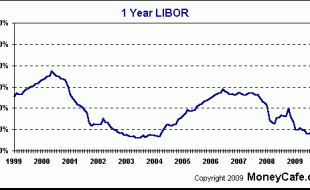
You may not know this, but the current 1-year LIBOR rate as of 9/5/2009 is 1.27% according to The Wall Street Journal and BankRate.com.
If your 1-year, LIBOR based ARM adjusted today, using the example above, then your new mortgage rate would be 3.625%.
Here is a graph showing the history of the 1-year LIBOR Index:

Refinance
Northern Virginia home appraisal X factor
May 29, 2009 by Doug Francis · Leave a Comment
You may think that you found the best rate for your home refinance, but there is an X-factor that may screw up the whole plan… and that is your appraisal! Also, see my response to a question on Trulia.
Refinance
Refinancing a mortgage in Virginia
March 15, 2009 by Doug Francis · Leave a Comment
Saving money is always why people want to start the hassle of refinancing. And with today’s fixed rates still around 5%, I get calls and e-mails from past clients with questions about their options all the time. It is nice to be considered their go-to guy when it comes to real estate questions, and now you too shall know the big refinancing secret strategy… as long as you live in Virginia.
In Virginia, it is essential that you start with your exact current lender.
Sure, but Doug the Internet is full of better looking deals than my lender’s web site, you say. That may be true, but the Internet is sometimes filled with people offering too-good-to-be-true deals. Don’t get me started on this topic right now because I will cover that issue later.
Again, in Virginia, if you refinance with the same lender then there is a “recordation tax exemption” for the mortgage. In my case, that would be about a $3,000 savings right off the bat! For those of you with a legal background or curiosity, you may reference §58.1-803 (D) of the Code of Virginia.
Bet this sounds like a good idea for those of you looking over those Truth-in-Lending Estimates right now. Everyone loves to skip paying taxes on anything if it is allowed by law, that’s the American way. But watch out for those pitchmen who say they can pull off that exemption because if it isn’t exactly the same lender then you may be going to jail for six months and paying a $1,000 fine. That will screw up your security clearance!
The refinance needs to be with the exact same lender. It has to do with being the same legal entity and subsidiary mortgage companies do not qualify. A “Division” of a bank does qualify. What?
Here are some direct examples from a recent letter from the Clerk of the Fairfax Circuit Court (3/12/09): {document was removed from site}
This is the case of Bank of America and Countrywide. According to the 10K that Countrywide filed with the Securities and Exchange Commission, the merger agreement between Bank of America and Countrywide provides for Countrywide to merge with and into a wholly owned subsidiary of Bank of America. A subsidiary is a separate legal entity from the parent company. Therefore, an existing Countrywide loan being refinanced with Bank of America is NOT a refinance with the same lender.
Other examples of transactions that DO NOT qualify for the same lender exemption are:
1. JP Morgan Chase and Chase Home Finance, LLC. (Separate entity). However, we just received a letter from JP Morgan Chase stating that JP Morgan Chase is the actual note holder for deeds of trusts issued by JP Morgan Chase Bank dated on or after January 1, 2005, which are currently being serviced by Chase Home Finance LLC. In those instances the transaction would qualify as a same lender refinance.
2. Wells Fargo Home Mortgage and Prosperity Mortgage which is an affiliate of Wells Fargo Home Mortgage. (Separate entity).
3. Wells Fargo Bank, N.A. is a subsidiary of Wells Fargo & Company. (Separate entity).
4. The payoff statement shows that wired funds are to be sent to X bank for further credit to Y lender. If Y lender is different than the lender providing the refinance loan then it is not a refinance with the same lender. We have found this in Bank of America/Countrywide refinances. The Countrywide payoff statements instruct the settlement agent to wire the funds Bank of America and to further credit MRC. MRC is MMA Realty Capital. They are an investment firm. According to our research, MRC is the current lender, not Countrywide. Countrywide appears to be servicing the loan for MRC. This would not qualify for a refinance with the same lender exemption.
Contrast this with Wells Fargo Home Loan which is a DIVISION (not a separate entity) from Wells Fargo & Company and BB&T Mortgage which is a DIVISION of BB&T Bank. A division is not a separate entity. Transactions in these situations would qualify for the refinance with the same lender exemption.
Why does the Clerk care so much about this issue? Because the Clerk may be personally liable for the uncollected money!
So now you know a little inside secret. If you are starting to look into refinancing then contacting your current lender is a must and absolutely the first call that you should make… and do your homework to make sure it is the same legal entity.
The law firm McGuire Woods posted a legal update on Refinancing with the same Lender in Virginia which is also worth reading. (I have no professional relationship with the law firm).
I am looking for comments from readers who have tried to refinance and their experience… successful or unsuccessful. It may help the next reader!


![Reblog this post [with Zemanta]](http://img.zemanta.com/reblog_b.png?x-id=ddf84333-8cc5-4d32-9581-b71e96850b6e)